
Creditors can often confuse (i) the outlawed practice of “phoenixing” with (ii) pre-pack administrations. The former is an abuse of the privilege of limited liability through (often repeatedly) liquidating a company laden with debts only to emerge shortly after under the guise of a new limited company, debt free, effectively carrying on the exact same business with the same name, premises and people.

“He has extensive offshore experience that is invaluable in understanding the structures that we are often dealing with” “Sam is enormously bright, very hard working and a super-pleasant fellow” “Sam combines sound technical knowledge with a great demeanour and client manner”
Questions & Answers
The High Court has today given judgment in the insolvency case of Young v Nero Holdings Ltd [2021] EWHC 2600 (Ch), determining that the company voluntary arrangement ("CVA") which was on the brink of approval by creditors was not capable of challenge by an aggrieved (yet well supported) landlord, Ronald Young.
As we move closer to a global recession caused by the current pandemic, some companies will find themselves in the unfortunate position of having to seek bankruptcy relief. This may have some important and often overlooked privacy implications. There is no question that in this day and age, one of a business’ most valuable assets is the personal information that it has collected from its customers and/or end-users – often more so than any of its tangible assets.
In Her Majesty the Queen v. Canada North Group Inc., the Supreme Court of Canada (the Court) held that lower courts can permit the grant of court ordered charges under the Companies’ Creditors Arrangement Act, RSC 1985, c C-36 (the CCAA), including the interim lender’s charge, in priority to the Minister of National Revenue’s (the Minister) statutory deemed trust claims under the Income Tax Act, RSC 1985 c 1 (the ITA).
The High Court has dismissed an application by a landlord creditor to overturn a company voluntary arrangement (CVA) implemented by coffee shop chain Caffé Nero. The CVA, previously approved by its creditors, compromised rent arrears and reduced future rents for the company's premises. The decision follows a series of previous high-profile challenges to retail and leisure CVAs.
The new month sees a partial re-instatement of the legislation permitting creditors to serve winding up petitions on companies. However, the UK Government has adopted a softly, softly approach; this is seen from the temporary increase in the amount that must be owed from the modest £750 to £10,000 and the requirement for creditors to seek proposals for payment from a debtor business, giving them 21 days for a response, before they can proceed with winding up action. The measures are said to protect small businesses as they seek to rebuild their stability.
In this article we look at current trends and developments at the intersection between insolvency and dispute resolution, including a rundown of some of the latest legislative changes, and issues to consider when litigating against parties in financial distress.
This analysis was first published on Lexis®PSL on 27 September 2021 and is republished with their kind permission.
Corporate Insolvency and Governance Act 2020
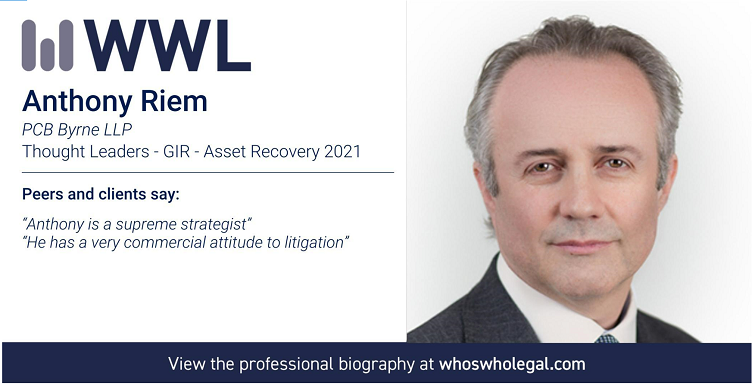
Anthony Riem is recognised as “a supreme strategist” by sources who compliment his “very commercial attitude to litigation”.
Questions & Answers
In a somewhat unexpected development given his recent appointment to a second 14-year term a mere 5 years ago, Bankruptcy Judge Robert D. Drain of the U.S. Bankruptcy Court for the Southern District of New York announced that he intends to retire as of June 30, 2022.