
Despite meeting statutory jurisdictional requirements under Part 26A of the Companies Act 2006, the High Court declined to exercise its discretion in favour of sanctioning Waldorf Production UK Plc’s restructuring plan in August 2025due to concerns about fair allocation of value and lack of meaningful engagement with unsecured creditors.
An insolvency practitioner (IP) can pursue a wide range of claims when appointed as the administrator or liquidator of a company.
These include claims that already existed at the point that the company entered an insolvency process (Pre-existing Company Claims), and ones that arise on insolvency (IP Claims see below).
An IP pursues Pre-existing Company Claims as agent for and in the name of the company, and these types of claims typically include claims for debt, breach of contract, breach of duty or recovery of property.
Restructuring Plans (RPs)
2024 was a year of firsts for RPs, and as case law in this area continues to evolve, there is little doubt that this will carry through into 2025.
It would be remiss not to expect to see more RPs in 2025. News of Thames Water's restructuring is "splashed" all over the press and Speciality Steel's plan might see the first "cram up" of creditors, but there seems a long way to go to get creditors onside.
目前对于陷入困境但仍具备重整价值及重整可行性的企业而言,破产重整是其实现风险出清和企业重生的重要方式。在破产重整中,投资人参与的主要方式包括股权投资、资产投资和债权投资等,其中股权投资为较为重要的投资方式(其基本流程如下图),本文将结合实践,从投资人视角,浅析破产重整中股权投资的机遇和风险防范,以期为投资人参与重整投资提供帮助。
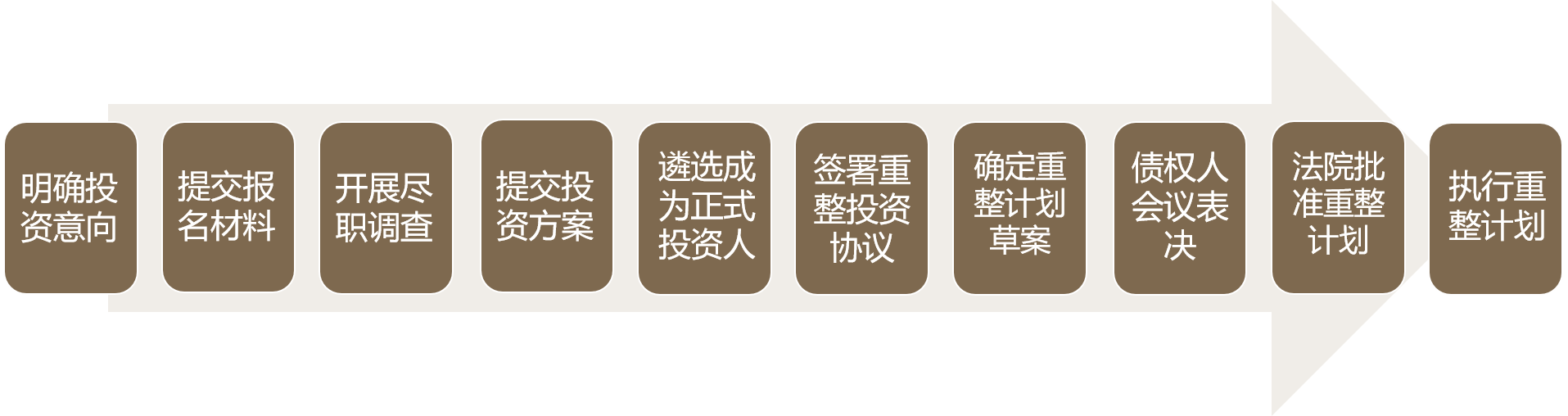
图1:破产重整中股权投资基本流程图
一、重整投资的机遇
现阶段,重整投资作为“新一轮招商引资”处于重要机遇期。以上市公司重整为例,2023年7月底的数据显示其中超90%的产业投资人和财务投资人账面呈现浮盈[1];2024年以来,截至11月,有44家上市公司被申请重整及预重整,较前一年同期增加超四成[2]。由此可见,破产重整蕴含着较多投资机会,其在目前政策环境、价值发掘、成本控制和业务整合等方面均展现出投资“机遇”。
The below sets out key considerations when dealing with an extension of an administration at the end of the first-year anniversary.
Categorisation of a charge as fixed or floating will have a significant impact on how assets are dealt with on insolvency and creditor outcomes.
Typical fixed charge assets include land, property, shares, plant and machinery, intellectual property such as copyrights, patents and trademarks and goodwill.
Typical floating charge assets include stock and inventory, trade debtors, cash and currency, movable plant and machinery (such as vehicles), and raw materials and other consumable items used by the business.
While there is a statutory requirement to register most forms of security granted by limited companies incorporated in the UK at Companies House, it is worth remembering that there is no statutory requirement for the holder of registered security to inform Companies House if, e.g., the debt secured by a registered charge has been satisfied.
Following our previous alert, in which we highlighted an issue with entries relating to registered security maintained at Companies House being incorrectly updated to indicate that they had in fact been discharged without the aware
Over the past week, reports have emerged about filings that have been made at Companies House marking a charge as satisfied, without the company's or relevant lender's knowledge.
There were rumours last week, which were simply that, because Companies House had not publicly announced any issue, but, as we have seen over the weekend and is now widely reported in the news, it appears that there have been at least 800 erroneous filings.
Changes are afoot to the statutory regime governing special administrations for regulated water companies (the SAR) following the publication of a suite of new legislation.
Impact of the changes on pension trustees