
The UK retail sector faces ongoing challenges from shifts in consumer behaviour and persistent economic pressures. In this light, Part 26A of the Companies Act 2006 has become a vital mechanism for struggling companies, enabling them to undertake a holistic restructuring, effectively using one process rather than combining the Part 26 scheme technology with the CVA as had been the case prior to the introduction of the restructuring plan.
Introduction
The High Court sanctioned Madagascar Oil Limited’s restructuring plan, exercising cross class cram down. The judgment deals with a few now familiar points: what is the relevant alternative? Can it be a different deal? As well as touching on a few novel ones in an unusual two class only plan: was there in fact an in the money class enabling cross class cram down? Almost a third of the judgment is devoted to international recognition and effectiveness of the plan in Madagascar and Mauritius, an unusually detailed analysis, but required here given the specific facts of the case.
In a significant further application of the Court of Appeal’s reasoning in Adler, Thames Water and Petrofac, the High Court declined to sanction a cross-class cram down restructuring plan proposed by Waldorf Production UK Plc.
On 12 June 2025, the Council of the EU announced that member states have agreed on a general approach to a directive aimed at bringing national insolvency standards closer together. This draft directive is designed to make the EU more attractive to foreign and cross-border investors by reducing the legal uncertainties and complexities associated with differing national insolvency laws.
Introduction
On 20 May 2025, Mr Justice Marcus Smith handed down his eagerly-awaited judgment sanctioning the two inter-conditional restructuring plans (the Plans) proposed by members of the Petrofac Group. The judgment raises issues described as “going to the heart of the Part 26A regime” and is significant as the first case to consider the application of the Court of Appeal’s ruling in Thames Water.
The judgment addresses three particularly interesting points:
On 8 April 2025, Mr Justice Marcus Smith delivered judgment granting Petrofac Limited and Petrofac International (UAE) LLC (the Plan Companies) permission to convene creditor meetings in respect of two inter-conditional restructuring Plans (the Plans). The fulsome judgment, following hearings on 28 February and 20 March, contains a number of interesting points:
The Sino-Ocean restructuring plan is the first to be sanctioned in 2025 – but it starts the year off with a very interesting bang. In a relatively short (and commendably clear) judgment, the Court addresses head on:
New rules in the UK allow Companies House to share non-public information with insolvency officeholders and the Official Receiver.
While in many cases there may be limited non-public information available from Companies House that will be useful to insolvency officeholders, this is another tool available to deploy in appropriate cases. It is specifically envisaged to assist officeholders pursuing claims for fraudulent and wrongful trading, transactions at an undervalue and preferences.
目前对于陷入困境但仍具备重整价值及重整可行性的企业而言,破产重整是其实现风险出清和企业重生的重要方式。在破产重整中,投资人参与的主要方式包括股权投资、资产投资和债权投资等,其中股权投资为较为重要的投资方式(其基本流程如下图),本文将结合实践,从投资人视角,浅析破产重整中股权投资的机遇和风险防范,以期为投资人参与重整投资提供帮助。
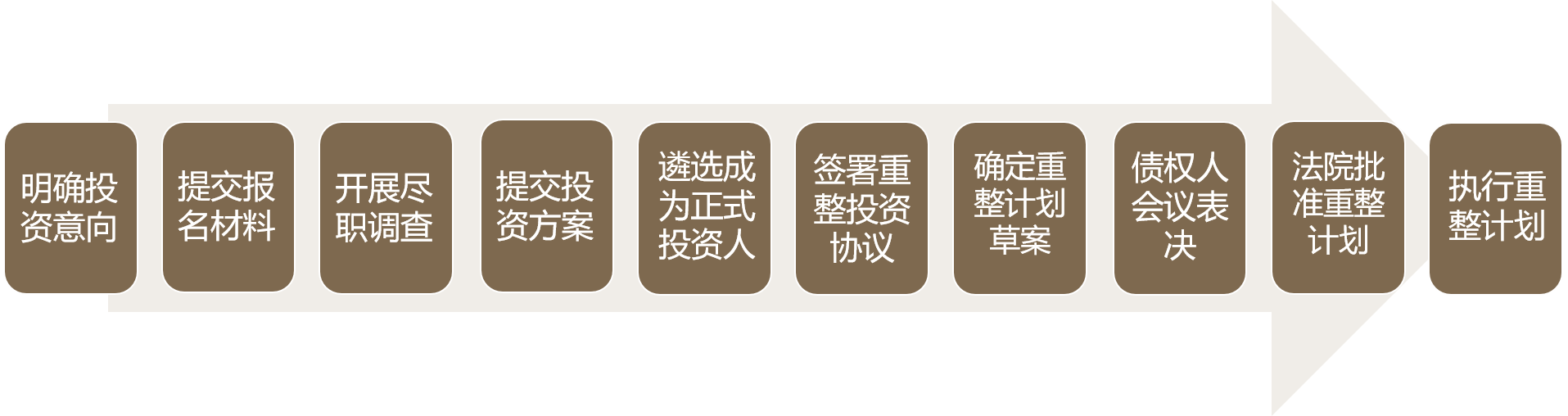
图1:破产重整中股权投资基本流程图
一、重整投资的机遇
现阶段,重整投资作为“新一轮招商引资”处于重要机遇期。以上市公司重整为例,2023年7月底的数据显示其中超90%的产业投资人和财务投资人账面呈现浮盈[1];2024年以来,截至11月,有44家上市公司被申请重整及预重整,较前一年同期增加超四成[2]。由此可见,破产重整蕴含着较多投资机会,其在目前政策环境、价值发掘、成本控制和业务整合等方面均展现出投资“机遇”。